
The Machine
“It can’t be bargained with. It can’t be reasoned with. It doesn’t feel pity or remorse or fear and it absolutely will not stop, ever.” - Kyle Reese (Terminator, 1984)

A reasonably accurate machine is your most valuable piece of training equipment. It is much more accurate and efficient than a fungo and can be fed by anyone, allowing the coach to be with the tribe where the magic happens. It creates a baseline and becomes a relative constant while the positioning of the players can now be the variable.
To start, the focus is on the front quadrant and a smooth transition through the pillars. The baseline target landing spot for the ball is ~225’ away from the machine with an approximate 5-6 second hang time. How the balls are fed (seam or flat surface) and the wind will create a little variability, but overall the environment can be reasonably controlled. Mark the spot on the ground where the balls are generally landing with a piece of tape, leaf or lightly score the grass. This is the spot where the defender is going to rhythm into when the ball comes out of the machine.
The progression and conversation start in 1st gear, with the current conditions creating a small radius around the marked spot. (Just to be clear, they have to stay in 1st gear, so if the ball is outside of their range in 1st gear simply have them let it go and move on to the next.) The goal is for the defender to understand the pace needed to make plays that increase in the level of difficulty as the variables change. More specifically, the level of relative urgency required and the amount of time presented in order to commit to a course of action. Physically, the intent is to check all the boxes of the pillars and bullseye the ball with direction straight toward the machine. Simulating a fly ball directly to the centerfielder and the play going to home plate.
In 1st gear, you need to get online with the machine with enough space and time to smoothly rhythm online through the bullseye. In this example, pay attention to the actual distance travelled in 1st gear. He would barely traverse that far if he was casually walking down the street. This is literally what this phase of the drill would look like on a fly ball that is just under 6 seconds as he calmly but precisely uses his time to put himself in a position to do what the ball is asking him to do.
Obviously, 6 seconds is more than enough time to accomplish all tasks required. Here is where the drill starts to separate from 10 year olds to professionals and everywhere in between. If the 10 year olds do not progress out of this first stage, then that tells you as a coach to keep the drill right where it is.
The range boundaries in this drill are not a perfect circle with the point of origin not being in the center either. The level of relative difficulty are listed in order from A to D. Visualize this for a right handed thrower (B and C switch for the left-handed thrower):
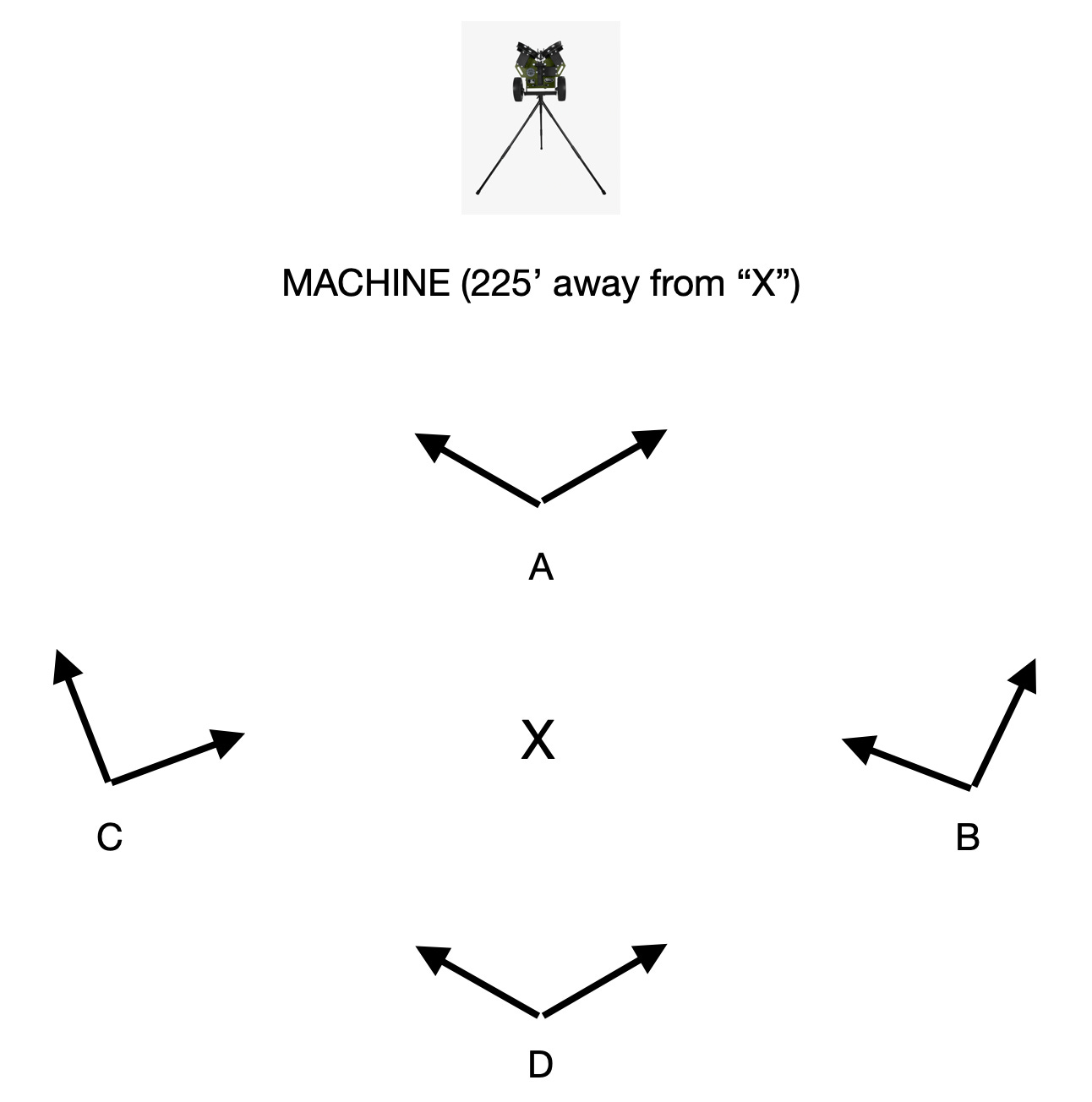
A = Least amount of relative urgency.
B = For a right handed thrower, their hips are already on the high side of the ball.
C = Slightly more to do to get the hips outside of this ball. Ideal opportunity to introduce the leg swing.
D = requires the most efficient use of time to get far enough behind the ball
If the ball does not allow for space in front quadrant presentation, then there is a critical decision that needs to be made even at this slow pace. The defender should acknowledge the situation by gearing down into or close to 0 gear and either present for a bullseye and forehand spin on the glove side, or a backhand bullseye and release through the exit angle*. If they force the issue because they want to impose their will upon the ball, they will either have to cheat and gear up to 2nd gear (which defeats the purpose of the drill), or they get stuck underneath the ball with no space. Either way, the lesson learned is quite obvious and is a perfect opportunity to introduce the difference between the low and high side of the ball.
*Exit angles are the natural continuation of momentum through a bullseye. If you have leverage on the ball then you have earned the right to dictate the exit angle through the bullseye. If the ball still has leverage in a side or back quadrant, then the exit angle honors that leverage as a brief but critical transitional bridge to redirecting momentum. Ie… stop and plant on the arm side (backhand) and forehand spin on the glove side. Exit angles apply exactly the same with ground balls as they do fly balls.
For the more advanced defenders, you can progress rather quickly and start to increase the radial distance from their starting point to the marked spot. When you have reached the outer most boundaries of 1st gear, give them up to 2nd gear, 3rd gear and then cut them loose at full speed. The goal remains the same; do what the ball is asking you to do.
The main intent is to gain the individual awareness of where their boundaries are, how they can be improved and made more consistent. With a mostly set point of intersection they can systematically experience their range at all angles, and how to operate on the boundaries of it.
The play is not finished until the ball is exchanged, separated from the glove and in the “command” position. Basically, relaxed and at or near the bottom of the throwing arc / circle with a 4 seam grip. The reason it is so important to finish the play that way is because it crosses over with the throwing program, when dry work (covered in the next release) is being executed.
When you make the decision to adjust the time variable, do so gradually by half a second. In order to accomplish this and keep ground zero at 225’ you need to simply lower the machine slightly and may have to turn up the rpms a little. Make sure the bottom wheel is set at a higher rpm than the top wheel to create backspin.
As you progress all the way down to a line drive at this distance, the rpms will continue to go up as the time goes down. At 225’ the time will approximately be cut in half, so if the intent is to work within the boundaries of the front quadrant, you won’t be able to move them side to side too much. Their decisions will need to be clear and concise as their decision loop tightens.
The key concept on line drives is to take their eyes below the ball. That will guide their intent and more importantly their head to match the entry angle of the line drive. It’s a yes, yes on the intent until it is definitively a no, and then we can pull up. Same theme of testing their front quadrant boundaries, they don’t know until they push themselves and find out.
WHY 225’? 225’ represents a reasonable distance that a defender can get the ball to home plate through a cutoff man somewhere between 3.4 - 3.5 seconds from glove to glove. That corresponds to the amount of time it takes for a base runner with average speed to round 3B and get to home plate.
It also intentionally coincides with the dry work that is done at practice in the throwing program. The distance to your partner during dry work is 150’ and so is the approximate distance between the outfielder and the cutoff man on plays to the plate. That leaves 75’ from the cutoff man to the plate. Simple from left and right field with the first and third baseman. Slightly different coming from centerfield where the first baseman needs to be on the second base side of the pitcher’s mound. If the ball isn’t at least chest high and hits the mound it was never going to reach the dish on one or two hops in the first place.
Releasing the ball from 225’ toward the plate, the outfielder has one of the following abilities:
Arm strength to reach the plate on the downward arch of a one hop, in a position where the backside runner has to honor the cutoff man.
Arm strength to reach the plate on two hops with enough energy to be more efficient then being relayed.
Arm strength to get the ball to the cutoff man but needing to be relayed due to loss of energy.
SEND IT!! Carry the dish with no backside runner off of a fly ball.
On plays to third base the ability to throw the ball on a line, chest high at 150’ is enough to one hop it on target through the cutoff man; keeping the backside runner from advancing. To second base, there is no backside runner but there is a lead runner that could get spun home if the third base coach is savvy enough to see a blown cut off man out of the hand.
SOAPBOX
Missed cutoff men is one of approximately 8 factors that make up DRS but seems to be rampant at all levels. A significant amount of teams in college and professional baseball will publicly claim to value the margins, which outfield defense unfortunately falls into. If that were true, then why is it not actually valued when the games start. It’s as if they are unwilling to commit to this aspect of the game being a controllable. Pitch counts and bullpen depth are directly impacted by how we train and the mindset we maintain. “Stick an athlete out there and he’ll be fine” echoes in my nightmares.